

Individuals are quick to forget that other people around them exist. I cannot think of a claim on human nature less difficult to defend. Just yesterday, a person on the trail I was cycling on suddenly moved into my path in an effort to pet a cute dog on the other side of the path. Perhaps that’s on both of us for not better managing the common space between us on the trail, but regardless, the default mode of us fickle humans is egocentric bias. Out of this rational self interest and imperfect ability to comprehensively analyze the risks associated with every action, the well-known Tragedy of the Commons is born.
Originating from Economist William Forster Lloyd, the idea of the tragedy is simple: it describes a situation in which individuals who have unhindered access to a resource (by social or governmental rules), they will act in their own self-interest and deplete said resource through a group’s own collective actions to exploit the resource. In modern economic contexts, these “commons” are any open access, unregulated resource from something small like the pool at your apartment to the atmosphere or animal populations of the natural environment.
No more obvious is this than with global surface temperature data, which paints a clear picture of the effects human activity, fueled by a penchant for progress. These long term costs are fundamentally difficult to build in with the current economic system.

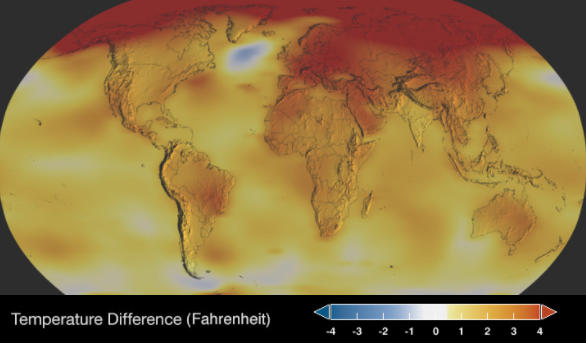
We see these resources being exploited on a daily basis, and we all exploit their shared use ourselves — whenever the car you are driving belches fumes, whenever you see someone litter, whenever you hear about the Great Pacific Garbage Patch or sea turtles eating plastic, even when you’re yet again stuck in traffic on a public (read: common) road. We all share much more of the pasture that we graze on than we realize.

We solve the use of common resources by construction of social structures that are able to force a price on negative externalities from “pollutive” actions through top-down regulations or even privatization (and ensuing sustainable consumption). Interestingly, there are historical cases of societies regulating access to a common resource in order to prudently avoid collapse such as the Balinese irrigation system, Subak, developed in the 9th century. The former, top-down approaches are methods particularly popular in the modern economic climate. We see that the Pigouvian tax is becoming a favored way of handling capitalism’s particularly troublesome penchant of racing to the bottom and crowding these negative externalities out of market price. While I will write about this kind of tax in the future, right now just consider some concrete examples: taxing (or banning) large sugary drinks, luxury items, or capping/taxing the amount of carbon generated by a market activity. The criticisms of this are obviously issues like measurement, the positive feedback generated by the marginal cost of improvement of the commons, and the inherent political nature of these taxes. These remain issues in the idea I present here, but I believe it to be interesting nonetheless.
In my opinion, one of the greatest failures of capitalist economic structures is the inability and lack of incentive of private entities to properly price the negative externalities of their production. Examples of this are a dime a dozen. Facebook shook democracy to its core. Oil producers et al. pumped toxins into the atmosphere. Textile mills centuries ago took advantage of proletariat labor and ground people to their bones. The typical solution is twofold:
1) governing bodies incentivize (via negative incentives, regulation) industry to cap these costs
and
2) consumers are supposed to consume consciously & sustainably, fixing the issue brought about by consumption with more (better) consumption.
Both of these are lagging solutions and are quite politically charged and subject to human nature, and as a result, they lag behind the effect they are trying to prevent and often prove less than optimally effective. I fear someday the concavity of the costs brought about by unconstrained capitalist behavior will be too great to properly mitigate and the structure will become completely unwound. But I digress
Option 1) gets a lot of attention, but to fully mitigate and price negative externalities within a capitalist framework is to bolster option 2), making it immensely more effective. With the internet and increased globalized capabilities of human society, using consumption to quick the negative feedback loop of sustainable capitalism is, in my opinion, an interesting and promising route that is very unexplored and potentially more robust. The solution to introducing a robust option 2) is to create a system with the embedded mechanism to account for externalities and incentivize economic entities to minimize the negative external effects produced by their activities and maximize positive effects.
Blockchain
Blockchain provides the unique ability to provide this. Enabling the “Internet of Things” and “digital democracy,” the blockchain offers a mechanism for collecting, storing, and recording data that will allow us to not only account for quantitative externalities (where a Pigouvian tax would be feasible) but also qualitative externalities as well (where quantitative assessment is ambiguous from unsettled property relations) via a public voting system and subsequent agreement. There are some works to refer to here assessing smart contracts and blockchain for this use, but I believe this to be a widely underappreciated capability of the blockchain technology. We can use it to dynamically internalize externalities into the currency people use to exchange and store value, something that is urgently needed in a global economic system that is structured in a way that generates spiraling negative externalities.
I’m not going to go into detail on the blockchain, smart contracts, or the nuance of initial coin offerings or blockchain finances, I’ll save that for another day. I’ve added some useful background in the appendix. I’ll discuss here instead a use case I find incredibly promising.
Blockchain is ideal for the procedures that come with recording and exchanging externalities in a magnitude of ways.
- The collection of data that will directly or indirectly estimate value. This is done by sophisticated monitoring through a community of experts, IoTs, or a specialized social network.
- Reliable and safe data storage
- Verification of data and subsequent open access, based on the cryptographic protection mechanism, providing both immutability and information verification. This also represents an important control loop: open access allows the population to asses the size of the externality via market forces.
- Emission of tokens on the blockchain, possibly backed by financing from state funds or the relevant project framework. This also represents an important control look that is currently lacking in markets for externalities that do exist, such as carbon markets, where producers of carbon credits can defraud the market by double-counting offsets.
- Exchange of tokens for the appropriate amount of funds (or goods, if the network is integrated enough).
- The tokenization of externalities and the system for managing the thresholds of said externalities. Conversion of these externality-backed assets will even be possibly based on the “floating” ratio of supply and demand on the part of entities and governance/population. This allows for an interesting price control I will touch on later.
- The externality-backed assets will be fungible, and externalities will be priced relative to each other instead of in isolation, adding yet another market force from investment/consumption that will allow the conversion on sustainability.
In theory, something like this could work for a myriad of negative externalities (and positive, if you wanted to reverse it, I think). Pressing issues like the volume of CO2 emissions, noise levels from transportation, overfishing, ocean acidification, garbage accumulation, space debris accumulation, road congestion, homelessness, even global pandemics or a requiem for physical isolation. All of this could be loaded onto this system, though it is not a solution: it is simply a mechanism to accelerate, fund, and ingrain these externalities within the existing economy. It is predicated on fast identification of these externalities and the subsequent production of a (scalable) solution.
Importantly, markets for externalities already exist on the international scale, notably the market for carbon emissions. As I’ve mentioned however, this system is marred with several issues that make it less than robust such as the potential for relatively easy fraud, opaque structure, and inaccessibility to the vast majority of the population that should be a direct (rather than indirect) stakeholder in the system.
Additionally, in many cases, the existence of this system on an international scale (which blockchain could somewhat enable w/o the need for 197 government agreements!) is absolutely critical. Tightening and incentivizing within a sphere of influence, production, or transport is not enough as the “dirty” externality producers will simply move or transfer the externalities to places in the globe where standards are not as strict or absent. This is rewarded in a capitalist system without internalized externalities, it becomes neutral or even costly in one with. Nowhere is this more apparent and annoying than the subjectivity of the Paris Agreement, after which the US was removed states like Texas that had massive potential for carbon offset credit were removed entirely from the international economic system (and thus incentive) to do so. Blockchain could at least open up rewards for sustainable infrastructure to all places of the world, a step in the right direction.
Let me briefly elaborate on how this might work and how we could mitigate & utilize the unique economics of this “externality-backed blockchain enabled asset.” I will use the carbon market as an example, as it is the simplest to understand and likely successfully implement this technology.
- A governing body sets a threshold for total carbon emissions, thus incentivizing industry to proactively neutralize its carbon output, the externality here. Alternatively, the Greta Thunberg effect takes hold and individuals choose to offset externalities independently. In both cases, a robust market is critical for accelerating the internalization of the externality.
- A blockchain ledger is created by a neutral third party or even a private entity. It’s a blockchain, so the incentive here holds.
- A neutrally obliged party such as a university assesses various carbon offset proposals by private industry and corroborates the proposed efficacy of the reduction in externality.
- Another party or two could be involved in assessment here, but the more “price” discovery to the upside available, the better.
- The proposal is published for public scrutiny along with an initial coin offering of an externality-backed asset on either an existing network, such as Ethereum, or it’s own. The Asset is optionally backed by funds in order to peg the asset to an actual currency for increased market opportunities or stability.
- The ICO (initial coin offering) is funded and contractors bid for the offset project.
- Investors from corporations to retail individuals speculate on the proposed project offset and invest in the asset accordingly. While the asset has float, it can be used as a currency, fungible for goods and services and tying sustainable efforts entirely back into the economy.
- The project is completed and networks of people, third party experts, and IoT estimate the amount of carbon the project offset.
- Findings are published and the tokens are exchanged for the value of carbon offset via purchasers of the credits. Repeat.
There are a few innovative private companies already working to implement carbon credit blockchain to solve the issues elaborate on above, namely Uphold and Nori. These are great projects that I’ll discuss another time: for now, they are exemplary trial runs of something I believe can be significantly expanded upon.
Obviously, there are several kinks here, including the incentive for a retail investor to invest in an asset that is essentially an option on something good being done anyway as well as inherently depreciating as the more projects that are built to offset carbon, the lower the value of a carbon credit would seem to get.
Other issues include the price volatility of the externality-coin if it were based on an existing crypto, such as Ethereum, which would fluctuate on its own. Solutions to this include using contracts with investment entities to accept risk in exchange for upside in the externality-coin, or freezing funds from the ICO in a USD based escrow, or simply developing an entirely new blockchain specifically for externality-based price action.
One of the coolest economic implications of such a system in my opinion, is the reversal of the traditional currency structure. Externality-backed tokens are inherently depreciating because while their value may spike due to demand for externality-neutrality within a population or the mispricing of a quantitative effect by the ICO, every increase (at least locally) of total carbon offsetting capability available on the market (in this case) has a higher marginal cost. Diminishing returns on fixing an externality, at least eventually. So while holding CarbonCoin for a year might be a great idea, holding it to store your bank account for 10 would likely be a terrible idea if left to market devices. What is really interesting is that the governing body could enact essentially price controls on the externality, lowering the ceiling of inexpensive carbon emissions gradually to even make the CarbonCoin an appreciating asset until the limit of 0 allowed emissions. Though the goal of this system is to create an economy that is sustainable independent of governing regulations, internalizing externalities as currency does require some sort of overhead incentive to allow them to store value, unless sustainability becomes absolutely paramount for investors/owners. This system of blockchain externalities is very promising to turbocharge that process and enable individuals and corporations vastly more access and transparency, crucial in holding the economy accountable for its actions and pricing in more accurately the profound downside to which we are all currently exposed.
Appendix
https://www.investopedia.com/terms/b/blockchain.asp
https://ethereum.org/en/developers/docs/smart-contracts/
https://blogs.oracle.com/blockchain/
https://www.cato.org/blog/problem-pigouvian-taxes
 To Be Determined
Leave a comment